
Perfect Days
Komorebi: Beauty in Presence

Behold, a cedar in Lebanon, with beautiful branches shadowing the forest.
-Ezekiel 31:3

Shadows shimmer and dance across the forest floor. The wind gently curves and glides her way through the tree tops whispering undisclosed mysteries. The path becomes alive; a river of shadow and light. Every movement: a unique and irreplaceable glimmer of beauty never seen before and never to be seen again.
It is a rare thing indeed, and careful to be observed, when a piece of art is capable of speaking to one’s hidden depths especially when such art declines to explore what is widely considered to be valuable or important. And yet, this seeming lack of ambition is precisely what makes Wim Wenders and Takuma Takashi’s 2023 film Perfect Days so unique.
It must be said, this film is odd. While not entirely silent, the protagonist, Hirayama, is silent for much of the runtime with perhaps ten to fifteen lines of dialogue. However, everything we as the audience need to know about Hirayama is clearly conveyed in the towering performance of Koji Yakusho. It is hard to express what exactly makes this film so special. Like any movie, the magic is in the viewing itself, not in the retelling of the basic plot points. But there is a certain attitude, a mindset, that clearly separates this piece apart from what is generally on offer in the film industry. I cannot conceive of another story that is able to so deeply and convincingly enrapture the viewer over what is basically a one-week slice of a working man’s life. Nevertheless, after I finished watching the film it became clear to me that there were important lessons that feel as sorely needed now as they ever have been.
Hirayama, in my estimation embodies the spirit of a modern philosophy and movement known as slow living. Slow living grew out of and as an extension from the Italian “slow food” movement in the mid 1980s that sought to reject the fast-food models of globalist chains like McDonald’s and Chick-fil-A in favor of home-made, local, small-batch, organic, and if possible home-grown foods. At its core was a desire for wholeness, not only as a means of health (although slow food is indisputably healthier in nutritional content and simplicity than fast food), but as a means of putting the brakes on and potentially reversing deteriorating local cultures more generally. Slow living became a way of bringing this attention from the disintegration of local food cultures into a broader consciousness about the disintegration of our communities and, perhaps most insidiously, of our very minds.
It is important to mention that slow living is not a form of Luddism. It is not a rejection of new technologies outright because they are new technologies (of course even that description is unfair to the real and now obviously vindicated sentiments of the first Luddites). However, it begins by asking the question, common in Old Order Amish communities, “How will this technology1 impact my personal life, my family’s life, and my community’s life.”
I mention all of this, not because Perfect Days is a film about slow living, but because it shows us what slow living could look like. Naturally, the question remains: what does slow living look like? I suppose slow living, beyond the simple joy of decluttering one’s mental space from extraneous noise and distraction, is to focus on those things which are maximally meaningful such as family, friends, and high-quality hobbies. To live in such a way where every moment becomes an occasion for presence and, by extension, divine disclosure.
Hirayama clearly lives in a different mode of being than the people around him. This is not to say that he is disconnected from reality, quite the contrary, one senses that as he scrubs public bathrooms in downtown Tokyo that he is more intensely and vitally connected to reality than most of those around him. His life is nothing special per se, as it consists in the simple art of stopping and noticing—of seeing the transcendent in the mundane (or perhaps recognizing the mundane as that which is transcendent). He softly gazes upon the whole of life, whether eating lunch on the grounds of a Shinto temple or while waiting for someone to conclude their business in the restroom, with the eyes of gratitude in even the smallest of things. It is, or at least it seems as much to me, fulfillment of the commandment “Pray without ceasing.”2
It may seem ironic to describe such an irenic and beautiful way of experiencing life as being “simple” or “natural” when our experience so often indicates precisely the opposite. I will decline to argue that our current technological and societal circumstances make our capacity to enjoy this way of living harder. I think in all places and times humans have found it difficult to find this flow of life (one need only to read medieval monastic manuals to discover this for themselves). Our context, and the tools we have at our disposal do make it easier to live distracted lives outside of ourselves. However, we have always struggled in this way. The Buddhists describe this internal restlessness as “monkey mind”: a constantly moving, voracious, restless, oft-times irascible, and lacking in self-control state that characterizes our “normal” consciousness.
However, our natural state is to experience reality as Hirayama seems to experience it in all the simplicity and naturalness that implies. Hieromonk Damascene writes of this experience,
In finding the traces of the Way in nature,
The Sage found the simple nature from which man had departed.
“Return to the babe,” he said,
“Return to the state of the uncarved block, the pristine simplicity.
The primitive origin of man:
Here indeed is the main-thread of the Way”In his infancy, his primitive origin,
Mankind has been made to rejoice in the Way, his Source,
To abide in Him, to cleave to Him, and never depart3
Using Taoist terminology, Damascene reflects on the Christian understanding of the “Fall”: the primordial departure from bliss when we walked with God to a sense of separation from our ultimate Source and with one another. What is striking about this understanding is that when we find this “simple nature”, in which Hirayama abides, it is not that which is additive or extrinsic to our nature. Rather, it is a return to a prior more original state of “pristine simplicity” that we were meant ever to remain and never to depart. Simply put, our quotidian experience of monkey mind is itself unnatural to our stature as human persons. Divine communion is our most true and natural state.
A key theme of the film is exploring the relationship between leisure and work as well as rest, arising, almost as a third reality, when these two intervening poles of leisure and work are harmoniously lived. Slow living involves leisure, in fact it reminds us that high-quality leisure is an ingredient implicit and upstream to any healthy society. But slow living is not finally a way, means, or method of leisure alone. It also places great emphasis in work that is creative and vivifies one’s own life and the lives of those around them. It is the enjoyment of high-quality leisure in the form of wholesome hobbies, but also of taking pride in a job well done when it is completed with total attention. In this interplay of high-quality leisure and wholesome creative labor carried out with total attention that we then see the arising of a quality which binds these two activities together and gives them their meaning—rest. Hirayama engages in both his hobbies and work with the same level of child-like joy and careful attention and in so doing finds a gateway into rest. One of the important reminders about this rest is that it is rarely, if ever, confused or sullied with entertainment, the almost ubiquitous expression of “rest” in our modern society. Hirayama reads, goes to his local ramen shop and watches baseball with the other patrons, but his experience of rest is a true expression of rest, not mere mindless entertainment which serves as an escape from encountering true rest.
Hirayama shows us the meaning of true work: careful, slow, diligent, and mindful of the joys of a job well done not merely of a job finished and forgotten. Furthermore, through this true work we are invited into understanding the meaning of true rest. Ostensibly the world we live in is one with a tremendous amount of leisure time where there is a proliferation of holidays and long weekends—of Mondays off and endless bank holidays that bleed into each other. However, more often than not we feel more tired, strung out, and stressed than ever before in human existence. Despite all of the paid time off we accrue, rarely do we stop and intentionally engage in rest. Rather, our time is spent endlessly scrolling through an infinity of entertainment options for streaming or social media. We have, as a civilization, forgotten the true meaning of rest, but perhaps this is because we have also forgotten the meaning of true work and leisure.
In Hirayama’s case, he discovers meaning in his work as simple as it is, and in so doing, everything that he does then becomes an opportunity for divine disclosure. As a result of this, when he is not working, he is able to properly enjoy rest and engage in fruitful leisure activities whether it be carefully growing trees in his small apartment, enjoying whatever he is reading, or listening to one of his many music tapes. There is a simplicity in his rhythm of life. A simplicity and focus on his work, and of his leisure, and in that simplicity, he’s able to find a genuinely restful contentment with his life. What appears to be the most significant constitutive aspect of that contentment is satisfaction with the way that his life is as it is. A simplicity of routine that is dependable perhaps monotonous, and yet, like a flower blooming between two slabs of concrete, finds moments of genuine creativity and surprise.
For Hirayama, every moment is a moment electrified by the power of presence. He is a practitioner of mindful living, where he is encountering the divine in everything that he does, from eating a sandwich to reading a book to stepping out of his front door. In a scene that could easily be overlooked, Hirayama leaves his apartment and collects the usual accoutrement of his workday: keys, wallet, work-phone, and some loose change. However, the camera hangs back as he leaves through the front door focusing on his watch, left behind, as he goes to work. This scene is duplicated later in the film, as we follow him during one of his days off. Naturally he takes his usual retinue of items, but deliberately takes time to put on his watch before going to the laundromat—a task which requires the use of timekeeping.
In this, he embodies a concept that Eckhart Tolle explores in The Power of Now, in what he describes as “psychological time.” Psychological time is not an understanding of time as being “an illusion.” Rather, that time itself is bound to our conscious awareness. It is the act of projecting our mind to the future (useful for planning) or the past (necessary for recollection) but is not an aspect of our natural state that abides in a boundless present. What Tolle describes has a home within Christianity with its distinction of Chronos and Kairos. The former being something akin to clock-time or “psychological time.” It is what we normally think of when discussing time, necessary for scheduling and planning (or, more commonly, stressing). The latter being something like eternity, a quality of the age to come, that we experience like a wheel that turns, but with only one point ever touching the ground. In essence, what we would regard as the present.
Hirayama is a useful practitioner of chronos, while never leaving that deeper eternal state of kairos. When there are things requiring chronos, he uses it as it is needful but when this task is complete is also capable of setting it back down. Rather than being a slave to the next moment or to the past, he lives in each moment as if it is the only moment. He has a true understanding that whatever moment he is experiencing now is the only moment that there is. That theophany is available in every single moment. There is beauty, reality, and mystery that all remain hidden from view if we are trapped exclusively within an outlook of psychological time.
In a particularly moving scene, we see this distinction played out. He and his niece, Niko, are riding their bikes along a bridge. They come to a stop and admire the river. She asks if the river leads out to the sea. Hirayama confirms this for her, and she immediately suggests that they go visit the sea that very moment. He pauses and says, “Next time.” Niko, perplexed, inquires “when is next time?” Hirayama smiles and says “Next time is next time. Now is now.”
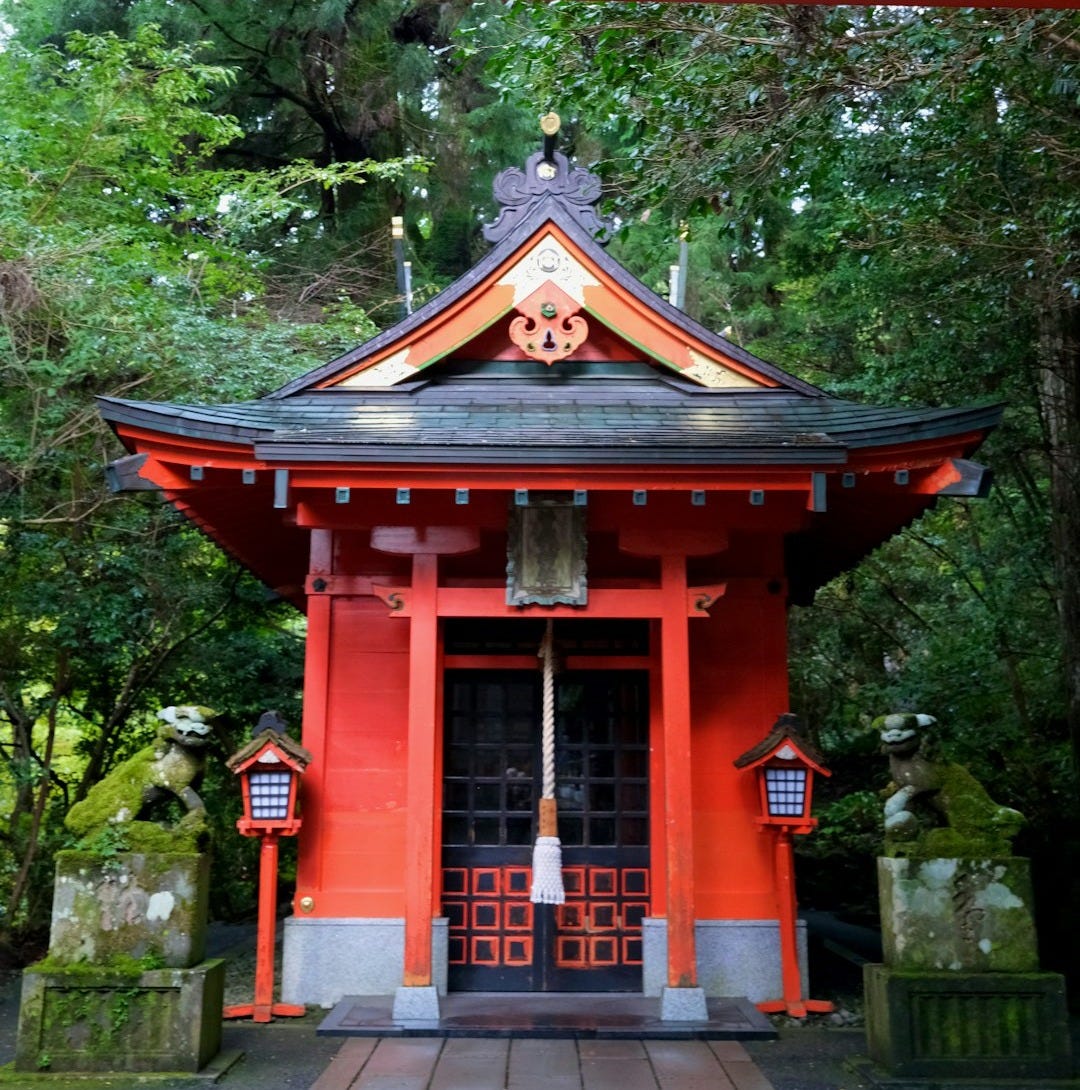
Komorebi, the Japanese word used to describe the interaction between the sun and the trees and the shadows they cast, is a shorthand to understand Hirayama’s philosophy. Komorebi can only be appreciated when we stop and notice. It is beauty available only in the instant of perception. It can never be captured because it is movement, and its beauty is in its impermanence. Komorebi is a reminder of beauty that can only be understood in an awareness of the eternal now.
All too often we are caught up in the desire for whatever is next. The new experience, the next best thing, that we are regularly incapable of appreciating the moment that we are currently experiencing as it is happening. Hirayama’s simple, child-like philosophy instructs us in a subtle way: there is nowhere to go except to be right here right now, because that is where we are. Anything else is insanity. And in a sense, it seems so obvious, but very often we live insane lives. We endlessly strive to not be present to what is in front of us and so we drown ourselves in any number of trivial pursuits the modern landscape has to offer us instead of truly being able to abide in the present moment. To rest in the joy of being. In the simple beauty that we encounter from moment to moment. Hirayama is instructing us in that deeper, slower, more sagacious way of engaging with reality.
By technology I do not merely mean something like an iPhone, although that certainly forms part of it. By technology, I mean any tool or technē, whether material or mental that aims at reducing effort towards a particular task while increasing output. By this definition I would include at the very least: the car, all computational devices such as phones and personal computers, social media, high-speed instantaneous communication, everyday appliances like electrical ovens, microwaves, blenders, and coffee makers, modern day bulk grocery stores, fast-fashion clothing stores, genetically modified foods, industrialized farming, industrialized animal husbandry, industrialized ore and mineral mining, 24/7 high speed internet, 24/7 electricity, industrialized book manufacturing, central heating and air-conditioning, the modern “job market”, our late-state/post capitalist “economy”, the commodification of “mindfulness” and other Dharmic contemplative traditions, and many more. Of course, picking up a rock and using it to break open a nut is also a “technology.” However, I believe there to be a certain qualitative difference (what that is, I have not worked out just yet) between this type of technology and the technologies I have listed above.
1 Thessalonians 5.17
Hieromonk Damascene, Christ the Eternal Tao. Platina: Valaam Books, 2017. 79
This very much had me thinking of “The Sacrament of the Present Moment”. I look forward to watching it.
As you describe it so well, it is easier said than done. Indeed, to be in the present, in the now should be what we all strive for as human beings, as God's people, since God is always in the eternal present. Thank you for the "Beauty in the Presence."